Bud Browne: A man who Filmed Surfing Into Existence

By
Ch12i5The Birth of a visionary
Before surf culture had a language, and long before it had a look, it had Bud Browne.
Born in Newtonville, Massachusetts in 1912, Bud Browne's path to becoming the father of surf cinema was anything but direct. A champion swimmer and lifeguard, Browne moved to California in the early 1930s to attend USC, where he captained the swim team. His early years were marked by physical discipline and water knowledge, skills that would serve him later not only behind the camera but inside the impact zone itself.
By the 1940s, he had relocated to Venice Beach and began surfing seriously. While serving as a swimming instructor in the Navy during WWII, Browne was already combining his two loves: the ocean and filmmaking. Armed with a humble 8mm camera, he began documenting surf scenes in Waikiki, a practice no one else had yet formalized.
Inventing the Surf Movie
In 1953, Bud Browne did something no one had ever done: he created a full-length surf film. Hawaiian Surfing Movie wasn't just a compilation of waves; it was a complete cinematic experience, projected in high school auditoriums, narrated live, and promoted with posters he designed and stapled to telephone poles himself. For 65 cents a ticket, audiences were transported to the warm, rolling waves of Oahu.
Browne wasn’t merely a filmmaker, he was an inventor of form. There was no industry standard, no playbook. He forged a new visual language by necessity, creating the genre of the surf film almost entirely alone. With no budget, no crew, and no predecessors, Bud Browne effectively became the surf world's first documentarian, promoter, and performance artist.
The DIY Auteur
Every element of Browne’s process was handmade. He shot the footage himself. He developed the film. He edited each reel in his tiny home setup. Then, with his own two hands, he loaded his car and took his movies on tour up and down the coast, stopping in dusty halls, gyms, and community centers. There, he would project the films, narrate over them live, and connect directly with his audience, often surfers who had never seen themselves on screen before.
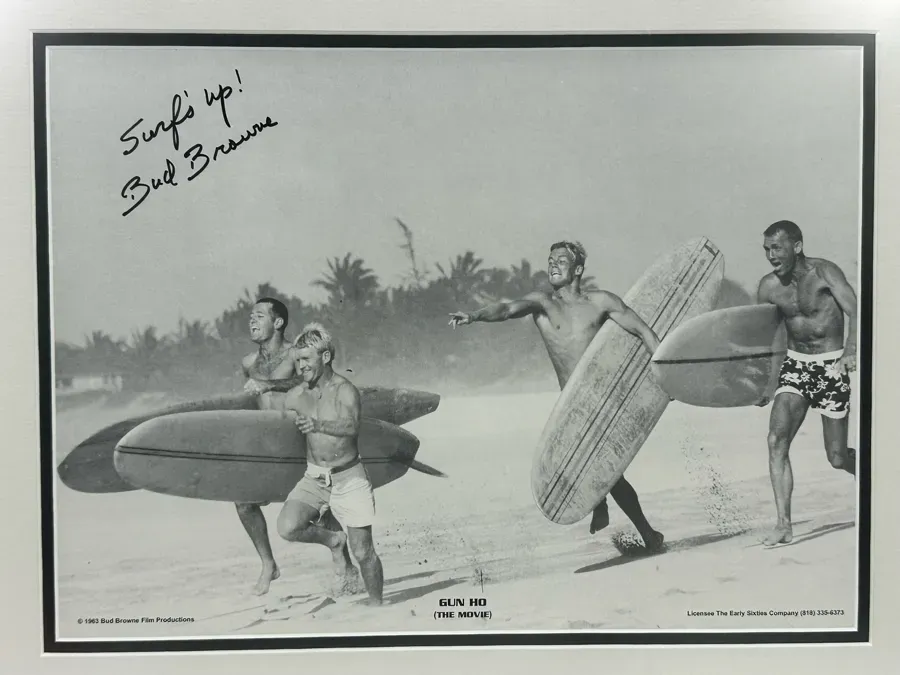
Between 1953 and 1964, Browne produced a new film every year, Cat on a Hot Foam Board, Gun Ho!, Locked In! each bearing his irreverent humor, innovative editing, and heartfelt love of the surf. These weren’t just surf clips; they were communal events, artifacts of a culture still defining itself.
Into the Impact Zone
Perhaps Bud Browne's most daring legacy lies not in the theater but in the lineup.
While other photographers stood safely on shore, Browne plunged into the sea with his homemade waterproof camera housings. He filmed shoulder-to-shoulder with the surfers, getting pounded at Pipeline, holding steady at Sunset, paddling into danger to get the shot.
At a time when filming in the water was almost unheard of, Browne’s footage stood out, not just for its intimacy, but for its physicality. He filmed as if he were one of them, because he was. The surfers trusted him, admired him, and sometimes accidentally surfed over him. Browne took it all in stride.
He became part of the lineup, and in doing so, he helped shape the visual mythology of the sport.
Inspiration and Influence
Bud Browne's impact can't be overstated. Bruce Brown, of The Endless Summer fame, once asked Bud for his blessing before releasing his first film. John Severson credited him as foundational to Surfer magazine's aesthetic. Greg MacGillivray, George Greenough, and countless others cite Browne as a godfather of their own cinematic pursuits.
What set him apart wasn’t just innovation, it was soul. Browne’s films carried an earnestness, a love for surfing and its characters. He wasn’t trying to sell surfing. He was trying to celebrate it.
The Art of the Frame
Later in life, Browne turned to a more esoteric artform: frame grabs. Before digital editing or still photography from video existed, Browne would painstakingly select individual frames from his motion film and print them in his home darkroom. These black-and-white prints, many of which he gave away to surfers and friends, captured fleeting moments of grace, a bottom turn, a shadow in the barrel, a spray frozen in time.
They were gifts from a man who had given his life to the ocean and to those who danced upon it.
Legacy of a Legend
Bud Browne passed away in 2008 at the age of 96, but his impact continues to ripple. He was inducted into the International Surfing Hall of Fame, the Huntington Beach Surfing Walk of Fame, and was honored with a Lifetime Achievement Award at the Surfer Poll Awards. His film Locked In! is still considered one of the finest surf films ever made.
Today, his archives, curated and preserved by Anna Trent Moore, form the most historically significant collection of surf film in existence. They remind us of a time when surfing was still young, and so was the camera that followed it.
Conclusion: A Camera and a Calling
Bud Browne didn't just film surfing, he gave it memory. He turned passing swells into stories, fleeting lines into legend. There was no one before him. No model to follow. He simply saw what surfing was, and what it could be, and decided to show it to the world.
And in doing so, he gave surfing its first mirror.